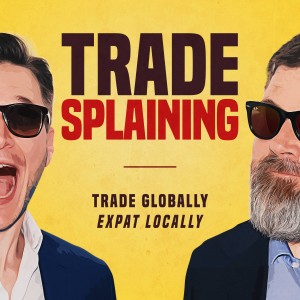
Trade Splaining
A fun and entertaining look at global affairs, trade and the United Nations, brought to you from the perspective of two American expats living in Switzerland. They try to keep a straight face while recapping the latest in current events and the local scene in Geneva, Switzerland as well as interviews with fellow expats on the international scene and leaders in their respective fields.








Episodes
Aug 13, 2026
Aug 13, 2026
33 min
Everyone weaponized trade policy at once this month, and the targets weren't always the obvious ones. Trump's latest tariff threats landed on the EU in retaliation for European fines on tech firms, which makes this a regulatory fight dressed up as a trade fight - and means every EU competition decision is now a potential tariff-triggering event. Add a threatened 100% tariff on generic drugs, and the low-cost end of the US supply chain starts looking fragile.
Meanwhile the bill from the Iran war is arriving late but arriving. Strategic reserves are thinning, diesel and jet fuel are tight, and the Houthis are now vowing a maritime blockade on Saudi Arabia, which puts the other oil export route in play alongside Hormuz. The New York Times Peter S. Goodman takes the diesel crisis all the way down to Bangladeshi smallholder farmers who need it to pump water, which is a useful corrective to the European trucking angle. Heat is doing macro damage too: Europe's grids were built for a different climate, and retrofitting Switzerland alone for cooling carries a price tag in the hundreds of billions of francs.
Then there's China, which is quietly running the export control playbook it spent five years complaining about. Beijing is tightening controls on outbound investment by companies and citizens, Huawei has engineered its way around US export controls with chip stacking and other workarounds, and the emerging assessment is that China came through the trade war in better shape than most of us assumed. Ardian and Rob get into whether export controls actually do anything beyond forcing innovation, whether the "Chinese model is collapsing" story is analysis or politics, and what it means for an export machine if the rest of the world eventually can't afford to buy.
Which leads to Europe. The EU is talking tougher on Chinese overcapacity and subsidies, but China can retaliate faster through rare earths and critical inputs. Brussels keeps signing rules-based agreements - Mercosur, Switzerland, the post-Brexit deal - covering tariffs, services, labour and environmental standards, digital rules and investment protection, while US deals go transactional and bilateral. The awkward part: Europe hasn't actually used any of those agreements against subsidized Chinese manufacturing yet.
Plus: TS correspondent Michelle returns from six months inside the Walmart employees subreddit with a report on drone cages in the parking lot, stolen Zebra scanners, and Walmart's two podcasts. There's a global whey protein shortage, a Geneva perch bumper crop, a man who allegedly stole a Sea-Doo in Canada and livestreamed his illegal border crossing, and an Air Canada pilot who spent 17 years in the cockpit without a licence.
🎧 Listen here: [link]
Jul 2, 2026
Jul 2, 2026
37 min
In Episode 90 of Trade Splaining, Ardian Mollabeqiri and Robert Skidmore are back to unpack how geopolitics, energy markets and global shipping disruptions are finding their way into the everyday economy — from oil prices and port congestion to pain au chocolat, ice cream cones and Aperol Spritzes.
We start with the Strait of Hormuz, where fears of an oil price shock ran into a more complicated reality. China’s role as a “swing importer,” existing oil supply gluts, demand destruction, rerouting and refinery adaptation all helped explain why markets did not quite melt down — even as the risks around energy security and logistics remain very real.
Then we follow the supply chain into breakfast and dessert. Why is a pain au chocolat more expensive? Why can an ice cream cone cost $8? The answer is not one input but many — wheat, butter, cocoa, diesel, refrigeration, labour, packaging and energy all moving in uncomfortable directions at once. Globalization, it turns out, is now coming for your snack budget.
This episode also features a conversation with Jan Hoffmann, Global Lead for Maritime Transport and Ports at the World Bank, on the latest Container Port Performance Index. Jan explains what the CPPI actually measures, why port rankings can get political, how rerouting through the Red Sea, Hormuz and beyond affects port performance, and why the global shipping map is changing in ways that are more about friend-shoring than near-shoring.
We also get into MSC vs Maersk, port ownership, shipping line-linked terminal operators, the geopolitics of port concessions, and — naturally — Jan’s ongoing haircut index and his Washington, DC kebab recommendation.
Plus: Gen Z’s anti-AI nostalgia, the World Cup heat dome, Bosnia’s unofficial theme song, Geneva’s Aperol Spritz problem, and why 320 kilos of meth is probably over the “personal use” threshold.
Listen now for a trade, shipping and geopolitics episode that connects the Strait of Hormuz, China’s energy leverage, port performance, global inflation and your next overpriced ice cream cone.
Jun 4, 2026
Jun 4, 2026
38 min
Episode 89 - Trade Finds a Way, But Your Parcel Might Not: Global Express Association's Carlos Grau on Customs, De Minimis & Global Delivery
Trade has a funny way of showing up in your life. Sometimes it is tariffs, oil prices and semiconductor supply chains. Other times, it is your package sitting at the border while someone tries to decide whether “gift” and “zero value” is a legally persuasive customs strategy.
In this episode of Trade Splaining, Rob and Ardian look at why global trade is still proving surprisingly resilient - even as geopolitics, shipping disruptions and rising trade costs keep trying to ruin the party. Goods trade grew strongly in early 2026, helped in part by US demand for AI-related products like servers, semiconductors and data center equipment. But that momentum is running straight into familiar risks: the Strait of Hormuz, energy prices, shipping uncertainty and the growing reality that trade may still find a way, but it might cost more and arrive later.
The episode also looks at Europe’s attempt to become a more serious geopolitical actor in supply chains, with the EU preparing stronger emergency powers over semiconductor production and critical chip orders. Rob and Ardian also revisit the eternal zombie file of Brexit, asking whether “Bre-entry” - Britain eventually rejoining or moving closer to the EU - is still political fantasy, strategic inevitability, or simply the trade policy sequel nobody asked for but everyone keeps watching.
The main interview features Carlos Grau Tanner, Director General of the Global Express Association, the Geneva-based association representing DHL, FedEx and UPS on global policy issues including trade, customs, aviation, air transport, security and postal regulation.
Carlos explains how express delivery works behind the scenes, why customs rules matter more than most people realize, and how the explosion in low-value e-commerce parcels is putting real pressure on border agencies. As more countries move away from de minimis thresholds, governments may collect more duties and taxes - but they also risk making customs procedures far more complex than they need to be.
The conversation gets into why a $20 parcel should not necessarily be treated like a container full of high-value goods, how simplified customs regimes could reduce friction, and why better data from platforms, payment systems and logistics operators could help customs authorities target risk without slowing everything down.
Carlos also explains why trade fragmentation is changing the global logistics map. As companies rethink where they produce, sell and distribute, express carriers need flexible air traffic rights and modern cargo rules that allow them to adapt to shifting trade lanes. In other words: if trade patterns are changing, the rules governing cargo aircraft need to change with them.
Plus: customs suspicion around gifts, why your grandmother’s sweater might need a declared value, whether kebab can be shipped internationally, Geneva’s kebab data set, Swiss cows facing cross-border restrictions, and the sad passing of Lazare, the local dog who almost made it to the world record books.
Listen now for a conversation on global trade, customs, e-commerce, logistics, supply chains and why the boring stuff at the border is becoming some of the most important stuff in the world economy.
May 21, 2026
May 21, 2026
34 min
Episode 88: Hormuz Oil Shock, Airfares and the Future of Flying - IATA’s Chief Economist on the New Energy Crisis
Oil shocks used to feel like something that happened in markets, headlines and awkward economist panels. Not anymore.
In this episode of Trade Splaining, we look at how the latest energy shock is moving from oil markets into the parts of the economy people actually feel - airfares, airline schedules, fuel tanks, EV demand, government energy policy and, potentially, your next holiday. The Strait of Hormuz crisis is no longer just a geopolitics story. It is becoming a consumer story, a transport story and a very expensive reminder that energy security still runs through some very narrow places.
This week, Marie Owens Thomsen, Chief Economist at the International Air Transport Association (IATA), joins the show to explain why aviation is facing what she calls a double energy crisis: an oil crisis and a refining crisis. Airlines do not fly on crude oil - they fly on jet fuel. And when jet fuel prices rise sharply, airlines face immediate pressure on costs, routes, pricing and survival.
Marie breaks down why sustainable aviation fuel is not as simple as “just make greener jet fuel,” why refineries are far more interconnected than most people realise, and why the future of flying depends on much bigger questions around energy systems, investment, infrastructure and political timelines. In other words: aviation may be only a small slice of refined fuel output, but when the system starts creaking, everyone notices.
Also in this episode: Trump and Xi apparently make trade nice again - details pending, napkins possibly missing - Europe’s airlines brace for higher costs, EVs get a crisis-driven boost, Swatch and Audemars Piguet release expensive pendant-shaped plastic, Switzerland accidentally gets a king, and Italy battles the real menace of our time: marauding peacocks.
In this episode:
How the Hormuz crisis is feeding into fuel prices, airline costs and travel disruption
Why jet fuel is not the same thing as crude oil - and why that matters
How higher fuel prices could affect airfares, routes and airline profitability
Why Europe may be especially exposed to aviation fuel shocks
Marie Owens Thomsen on IATA, sustainability and the future of air transport
Why sustainable aviation fuel requires a whole energy-system rethink
How refinery economics shape the future of aviation
Whether this crisis could accelerate renewable energy and alternative fuels
The strange incentives now facing governments, airlines and consumers
Switzerland’s self-declared king and Italy’s peacock problem
Featured guest
Marie Owens Thomsen is Chief Economist at the International Air Transport Association (IATA), where she is also responsible for environmental and sustainability activities and serves on IATA’s Management Committee. She previously worked at Lombard Odier as Head of Global Trends and Sustainability and has held senior roles across investment banking, private banking and international economics.
Keywords
Trade Splaining, IATA, Marie Owens Thomsen, aviation, airfares, jet fuel, oil shock, Strait of Hormuz, energy crisis, sustainable aviation fuel, SAF, airline industry, global trade, energy security, transport, geopolitics, supply chains, renewable energy, refining crisis, airlines, EV demand, global economy.
Apr 30, 2026
Apr 30, 2026
31 min
Episode 87 - USMCA Uncertainty, Trade Fragmentation & the Future of Supply Chains
Global trade is shifting - and not everyone agrees on where it’s heading.
In this episode, we break down the growing uncertainty around USMCA, the rise of trade fragmentation, and what it means when the system moves away from efficiency toward resilience.
We also sit down with Will Petty, Global Head of Product Development at A.P. Moller - Maersk Trade & Customs Consulting, to understand how companies are actually responding on the ground - from navigating tariffs to rethinking supply chains and compliance.
Key topics include:
Is USMCA at risk - and what happens if it unravels
Why the US is pushing bilateral over regional trade deals
The shift from “just in time” to “just in case” supply chains
Commodity fragmentation - from copper pricing gaps to stockpiling
Why resilience comes with real economic costs (inflation, inefficiency, volatility)
How companies are adapting to tariff complexity and geopolitical disruption
The growing importance of supply chain data, traceability, and compliance
Will supply chains get shorter - or just more complicated?
With Will Petty (Maersk), we discuss:
How businesses are reacting to constant disruption
The real-world impact of tariffs and shifting trade flows
Why understanding your supply chain is now a competitive advantage
The risk - and opportunity - of shrinking supply chains
Plus:
Expat insights
Geneva kebab rankings
And the unexpected return of… mall culture
Apr 7, 2026
Apr 7, 2026
28 min
Episode 86 – Is the WTO Still Relevant? MC14, Trade Chaos & a Surprisingly Resilient System | Peter Foster (FT)
🎧 Listen: t.ly/K4Jnc
Has the global trading system fundamentally broken — or is it proving more resilient than expected?
In Episode 86 of Trade Splaining, we sit down with Peter Foster, World Trade Editor at the Financial Times, to unpack the real outcomes of WTO Ministerial Conference 14 (MC14) and what they reveal about the future of global trade.
🌍 What we cover:
MC14: What actually happenedThe conference ended with limited concrete outcomes, highlighting deep divisions — particularly around the e-commerce moratorium and broader reform efforts.
Is the WTO still relevant?We explore whether the WTO is adapting to a new global reality or slowly drifting toward irrelevance in a world dominated by great power politics.
Rise of regional and plurilateral dealsAs consensus becomes harder, countries are increasingly turning to smaller coalitions and regional agreements to move forward.
Trade policy chaosFrom “napkin deals” to unpredictable negotiations, the current trade environment is becoming harder for governments and businesses to navigate.
The big paradox: trade resilienceDespite rising tariffs and geopolitical tensions, global trade flows have remained surprisingly stable — raising questions about how much has really changed.
🔑 Key takeaway:
Even in a more fragmented and politically charged world, global trade continues to function — not because the system is strong, but because the incentives to keep it going are still stronger.
⏱️ Timestamps
00:00 – Intro & episode 86 (Radon edition)03:20 – Interview with Peter Foster05:00 – MC14 recap10:00 – WTO relevance debate16:00 – Trade resilience vs tariffs20:00 – Future of global trade24:00 – Local news (Swiss cheese diplomacy 🧀)
📢 Follow & support
Twitter/X: @TradeSplainingInstagram: @TradeSplainingEmail: tradesplaining@gmail.com
Mar 18, 2026
Mar 18, 2026
34 min
Episode 85 – Tariffs Struck Down… Then Came Back + Middle East Conflict Threatens Food Prices
Have tariffs really been rolled back — or just repackaged under a different legal label?
In Episode 85 of Trade Splaining, we unpack the fallout from the US Supreme Court ruling on tariffs — and why, despite the headlines, not much may have actually changed.
We then turn to a fast-moving and underreported risk: how the Middle East conflict is disrupting global fertilizer supply chains — and what that could mean for food prices worldwide.
We’re joined by Peter S. Goodman (New York Times) to break down why this matters more than most people think.
🔑 What we cover
Why US tariffs were struck down — and how they came back almost immediately
What happens to the $133 billion in tariff revenues now in legal limbo
Whether trade policy has actually shifted — or just changed legal justification
Why supply chains continue to reconfigure rather than truly de-risk
How a third of global fertilizer supply depends on the Persian Gulf
Why urea prices spiked ~45% in a week — and what that signals
How fertilizer shortages translate into lower yields and higher food prices
Why globalization isn’t going away — despite rising geopolitical tensions
The economic incentives preventing a real shift toward resilience
💡 Key takeaways
The legal basis for tariffs may have changed — but the policy hasn’t
Tariffs remain a central tool of economic and geopolitical leverage
Supply chains are adapting, but not necessarily becoming more resilient
Global food systems remain highly exposed to geopolitical shocks
Efficiency continues to win over resilience — until crisis hits
🌍 Why this matters
From tariffs to fertilizers, this episode highlights just how interconnected today’s global economy really is.
Disruptions in one region — whether legal, political, or military — can quickly ripple across supply chains, prices, and everyday life.
And despite all the talk of “deglobalization,” the system remains deeply interdependent — and fragile.
📢 Listen & follow
If you enjoyed the episode:👉 Follow / Subscribe on your preferred platform👉 Share with a fellow trade nerd👉 Help us (and the algorithm) by leaving a rating or review
🔎 Keywords (for SEO)
tariffs, US trade policy, Supreme Court tariffs ruling, Middle East conflict, Strait of Hormuz, fertilizer supply, urea prices, global food prices, supply chains, globalization, trade policy podcast
Feb 12, 2026
Feb 12, 2026
33 min
Episode 84 is here — and yes, 84 is the atomic number of polonium, 1984 is Orwellian, and Van Halen absolutely peaked. You’re welcome.
We’re joined again by friend of the pod Dmitry Grozoubinski, Executive Director of the Geneva Trade Platform and author of Why Politicians Lie About Trade. And we ask the big question:
👉 Has the global trading system fundamentally changed — or are we just living through noisy turbulence?
We break down:
Why Rob’s 2025 prediction that “everything will look mostly the same” is… under pressure
Whether tariff chaos has permanently destroyed predictability
Why certainty matters more than tariff levels
The EU–Mercosur deal and what it really signals
The weakening of Most Favoured Nation (MFN) treatment
Why customs, sanctions, and rules of origin are about to get much more complicated
And Dmitry’s predictions for 2026 (spoiler: more tariff threats, fewer illusions)
Is this the end of the rules-based system?Or just a new phase where national security openly trumps trade orthodoxy?
Also: airplanes turning around because of toilets. Again.
Listen responsibly.
Jan 27, 2026
Jan 27, 2026
36 min
Is everything national security now?
In Episode 83 of Trade Splaining, Ardi & Rob kick off 2026 by diving head-first into the growing chaos at the intersection of trade policy, geopolitics, and national security exceptions — the legal loophole that ate the global trading system.
We break down why trade is no longer just about efficiency or tariffs, but increasingly about power, leverage, and security theatre — from Greenland and semiconductors to Japan–China tensions and WTO rule-stretching.
Then we’re joined (again) by two of our favourite adults in the room:
Dr. Mona Paulsen (LSE)
Prof. Greg Messenger (University of Bristol)
Together, we unpack:
Why “national security” now seems to cover everything except furniture
Whether today’s chaos is a temporary shock — or a return to how trade always worked
What businesses should actually watch for amid policy incoherence
Whether the US is still a reliable anchor for the global trading system
And why the real question isn’t what Washington does — but what everyone else does next
Plus:
A new 2026 format (more depth, fewer Lake Geneva anecdotes — we promise)
Sleep-bro optimisation culture (yes, really)
AI, soft skills, and why getting your boss coffee is apparently back
Donuts, laundry, and the National Security Exception™ as a life philosophy
🎙️ No opinions. Just vibes. And trade law.
👉 Listen now wherever you get your podcasts.📩 Questions? trade.splaining@gmail.com🔔 Like, subscribe, follow — appease the algorithm.
#TradeSplaining #GlobalTrade #NationalSecurity #Geopolitics #TradePolicy #WTO #SupplyChains #ListenResponsibly
Dec 29, 2025
Dec 29, 2025
35 min
In Episode 82 of Trade Splaining, Ardian Mollabeqiri and Robert Skidmore close out the year with an end-of-year global trade reality check.
This episode covers:
Why Europe’s energy transition is starting to hit household wallets
China’s overcapacity problem — from electric vehicles to tomato paste
Why tariffs are proving inflationary (again) and failing to cut trade deficits
How supply chains keep finding workarounds, no matter the policy
Rising debt and capital outflows facing developing economies
What “fragmentation” looks like in practice — and whether there’s a third way
No guest this time — just a wide-ranging news roundup, listener feedback, and a reminder that when pizza orders start shrinking, something bigger is going on.
🎧 Available on Apple Podcasts, Spotify, and wherever you get your podcasts.
📩 Get in touch: tradesplaining@gmail.com🐦 Follow us on Twitter/X & BlueSky | 📸 Instagram | 💼 LinkedIn
Listen responsibly.